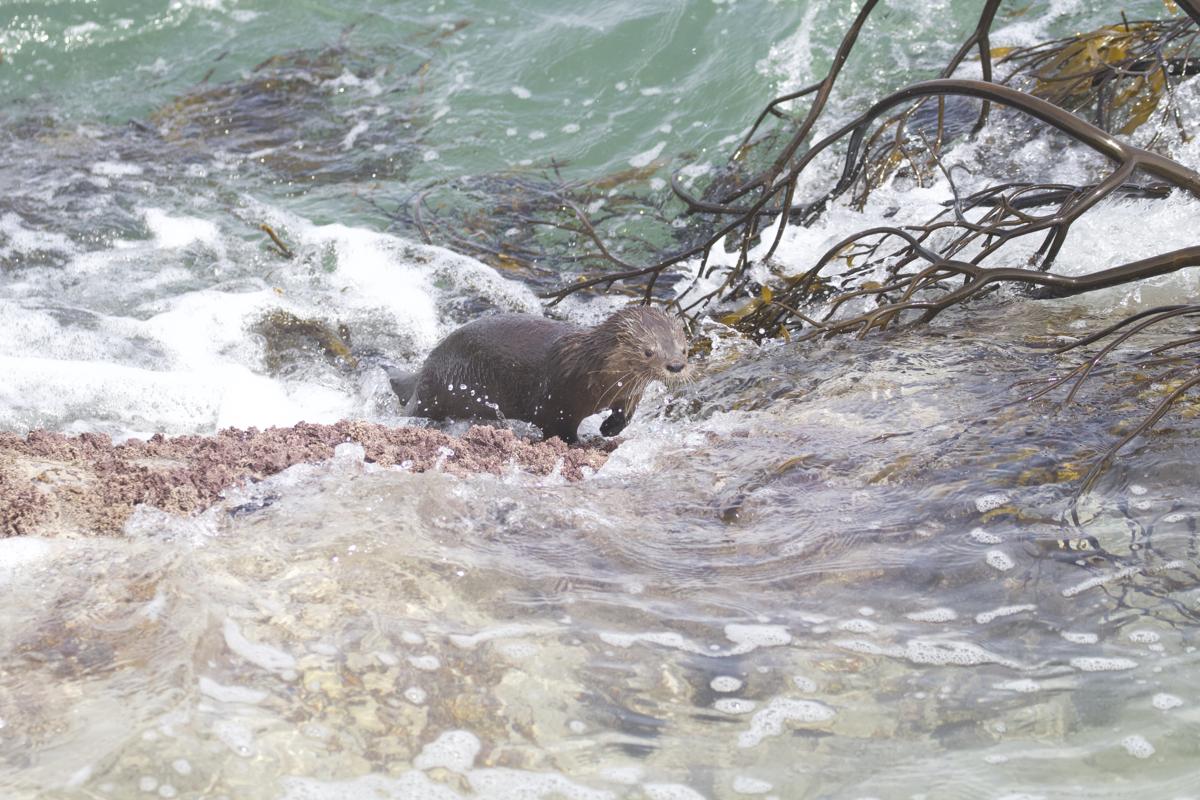
A 344-apartment development is planned on the Algarrobo headland, directly on top of critical habitat for one of Chile's most Endangered marine mammals: the chungungo (Lontra felina). Puya Conservation, in collaboration with the local organisation Defensa Punta Fraile, has submitted a technical report to the authorities making the case for why this project cannot proceed without a full and rigorous impact assessment.
No impact assessment but many threats to chungungos
On 9 February 2026, Chile's Environmental Assessment Service (SEA) ruled that La Puntilla, a large holiday apartment complex, is not required to enter the environmental impact assessment system (SEIA). As we document in our report, this decision represents a serious oversight in the protection of the chungungo (Lontra felina), an Endangered species facing a high likelihood of direct and indirect negative impacts from this development.Using multiple independent lines of evidence, our report concludes that the development would substantially increase human activity, dog presence, noise, artificial light at night, pollution, disruption of freshwater springs, and sediment runoff into adjacent intertidal foraging habitat, all factors known to negatively affect marine otters. None of these impacts were adequately considered in the fauna assessment submitted by the developer. Without a rigorous environmental impact assessment, this project risks causing irreversible harm to the local chungungo population, with consequences for the conservation of Lontra felina at both regional and global scales.
Critical deficiencies in the developer's fauna assessment
The fauna assessment submitted by the developer records a single chungungo sighting: one individual, on one occasion. This is inconsistent with the frequent observation of multiple individuals at this site, supported by a monitoring record stretching back to 2016 and corroborated by Puya's own field observations.
More seriously, the assessment classifies the chungungo as Vulnerable (VU), a legal status formally superseded in 2021, when Chile's 17th RCE Process elevated the species to Endangered. This misclassification is not a minor administrative error. It fundamentally misrepresents the species' legal protection status and the level of scrutiny that any threat to it or its habitat demands.
This failure is not unique to this project. A systematic review of 1,563 coastal development projects submitted to the SEIA found that L. felina was mentioned in only 12.6% of cases, and fewer than 1% proposed species-specific mitigation measures. The La Puntilla assessment follows this same pattern of inadequate consideration. Combined with the project's close proximity to the Santuario de la Naturaleza Islote Pájaros Niños, where one of the most important reproductive colonies for Humboldt Penguin is located, the absence of a legally accurate, species-specific assessment and any proposed mitigation measures constitute a critical procedural and legal deficiency that should prevent approval of this project under the SEIA.
Why the development is a problem
The chungungo is not primarily a marine animal. Studies show it spends up to 81% of its time on land, resting and denning in rock crevices and coastal caves. The proposed development sits directly on the coastal headland above this habitat. The core habitat for this population. Even if the rocks themselves are not disturbed, the constant presence of residents, dogs, and human activity along the coastal margin would effectively destroy the conditions that make these sites usable as core habitat.
Dogs are a particular concern. Research shows that free-ranging owned dogs regularly range 0.5 to nearly 2 km from home, with some exceeding 4 km. Dog attacks are a documented primary cause of chungungo mortality in Chile. A development of 344 apartments projects a lethal threat well beyond its immediate physical footprint.
What we are asking for
In our report, we are not saying further development should not happen in Algarrobo. We are saying this development, in this form, cannot be approved without a complete, independent, species-specific environmental impact assessment that treats the chungungo as an Endangered species.
Based on the evidence presented in our report and the broader scientific consensus on the negative responses of Lontra felina to coastal development and disturbance, we make the following recommendations:
- Reassessment of the SEA ruling exempting La Puntilla from entering the SEIA, in light of the evidence presented here regarding the chungungo's Endangered status, the regional importance of the Algarrobo population, and the high likelihood of direct and indirect negative impacts.
- A pre-construction baseline survey spanning at least two full seasons (summer and winter), characterising the number of resident individuals, home range boundaries, reproductive success, behaviour, and habitat use.
- Should the project proceed, implementation of adequate mitigation measures, including but not limited to: erosion prevention, protection of freshwater springs, pollution control in adjacent coastal zones, regulation of artificial lighting, noise control during construction and operation, integrated waste and wastewater management, and contribution to regular monitoring of L. felina populations.
- Implementation of a Municipal Chungungo conservation and management plan encompassing protection of critical habitats, human exclusion zones, dog control, lighting restrictions, environmental education, enforcement, and the establishment of continuous long-term monitoring of L. felina populations in the area.
Full report available upon request through our email puyaconservation@gmail.com
Selected references
Foerster P. (2020) Programa de monitoreo e investigación de Lontra felina (Chungungo) en Algarrobo.
Pavez et al (2026). Human Presence on the Coast Reduces Marine Otter Abundance. Marine Mammal Science
Programa de Monitoreo e Investigaci.n de Lontra felina (Chungungo) en Algarrobo. Informe Tecnico 2020. I. Municipalidad de Algarrobo, Departamento de Medio Ambiente.
Sielfeld et al (2024). The southern river otter, huillín, Lontra provocax (Thomas, 1908) and the marine otter, chungungo Lontra felina (Molina, 1782) (Mustelidae: Lutrinae) in the Southern Patagonian fjord and channel system: distribution and conservation problems. Anales del Instituto de la Patagonia
Toro et al (2026). Using spatio-temporal clustering to identify mortality patterns and anthropogenic drivers in the marine otter (Lontra felina) in north-central Chile. Frontiers in Marine Science
Puya Conservación, contribuyendo a los esfuerzos de la organización comunitaria Defensa Punta Fraile, ha presentado un informe de conservación formal en oposición a un proyecto de desarrollo residencial de 344 departamentos en La Puntilla, en el promontorio de Algarrobo. Esta es la razón por la que creemos que no debería llevarse a cabo.
Muchas amenazas para los chungungos, ninguna evaluación de impacto
El 9 de febrero de 2026, el Servicio de Evaluación Ambiental (SEA) de Chile resolvió que La Puntilla, un extenso conjunto habitacional de uso turístico, no está obligado a ingresar al Sistema de Evaluación de Impacto Ambiental (SEIA). Como documentamos en nuestro informe, esta decisión representa una grave omisión en la protección del chungungo (Lontra felina), una especie En Peligro que enfrenta una alta probabilidad de impactos negativos directos e indirectos derivados de este proyecto.
A partir de múltiples líneas de evidencia independientes, nuestro informe concluye que el proyecto incrementaría sustancialmente la actividad humana, la presencia de perros, el ruido, la iluminación artificial nocturna, la contaminación, la interrupción de vertientes naturales de agua dulce y el arrastre de sedimentos hacia el hábitat de forrajeo intermareal adyacente, todos estos siendo factores conocidos por afectar negativamente a las nutrias marinas. Ninguno de estos impactos fue adecuadamente considerado en la evaluación de fauna presentada por la empresa inmobiliaria. Sin una evaluación de impacto ambiental rigurosa, este proyecto arriesga causar daños irreversibles a la población local de chungungos, con consecuencias para la conservación de Lontra felina a escala regional y global.
Deficiencias críticas en la evaluación de fauna presentada por la empresa inmobiliaria
La evaluación de fauna presentada por la empresa inmobiliaria registra un único avistamiento de chungungo. Un solo chungungo. Este resultado es inconsistente con la observación frecuente de múltiples individuos en el área, respaldada por un registro de monitoreo que se extiende desde 2016 y corroborada por las observaciones de campo del equipo de Puya Conservación.
Más grave aún, el informe clasifica al chungungo como Vulnerable (VU), una categoría desactualizada y superada por decreto desde 2021, cuando el 17° Proceso RCE elevó formalmente la especie a la categoría En Peligro (EN). Esta imprecisión no es un error administrativo menor. Representa una falta a la protección legal de la especie y del nivel de rigor que cualquier amenaza sobre ella o su habitat que la ley exige. Lamentablemente, este patrón no es exclusivo de este proyecto. Una revisión sistemática de 1.563 proyectos de desarrollo costero ingresados al SEIA encontró que L. felina fue mencionada en apenas el 12,6% de los casos, y menos del 1% propuso medidas de mitigación específicas para la especie. La evaluación del proyecto La Puntilla es consistente con este patrón de consideración inadecuada. Sumado a la proximidad del proyecto al Santuario de la Naturaleza Islote Pájaros Niños, donde habita una de las colonias reproductivas más importantes del Pinguino de Humboldt, la ausencia de una evaluación de impacto jurídicamente precisa y específica para la especie, y la falta de medidas de mitigación, constituyen una deficiencia procesal y legal crítica que debería impedir la aprobación de este proyecto bajo el SEIA.
Por qué este proyecto es un problema para los chungungos?
A pesar de ser una nutria marina, el chungungo pasa hasta el 81% de su tiempo en tierra, descansando y refugiándose en grietas rocosas y cuevas costeras. El proyecto se emplaza directamente en el promontorio costero sobre este hábitat. El habitat clave de esta población. Aunque las rocas en sí no sean removidas, la actividad humana y la presencia de perros a lo largo del borde costero comprometerían las condiciones que hacen de estos sitios un habitat ideal y utilizable para la especie.
Los perros son una preocupación mayor para esta especie. Investigaciones muestran que los perros domésticos que deambulan libremente pueden alejarse entre 0,5 y casi 2 km de sus hogares, y algunos superan los 4 km. Los ataques de perros son la principal causa de mortalidad conocida del chungungo en Chile. Un proyecto de 344 departamentos proyecta una un aumento en la densidad de perros circulando en esta zona, lo que podría derivar en una amenaza letal para los chungungos más allá de la huella física de este proyecto.
Nuestras recomendaciones para proteger al chungungo
No estamos en contra del desarrollo en Algarrobo. Como organización, presentamos este informe para argumentar que este proyecto, en esta ubicación y en esta forma, no puede ser aprobado sin una evaluación de impacto ambiental completa, independiente y específica para la especie, que trate al chungungo como una especie En Peligro.
En base a la evidencia presentada en nuestro informe y al consenso científico sobre las respuestas negativas de Lontra felina al desarrollo y alteración del borde costero, formulamos las siguientes recomendaciones:
- Reevaluación de la decisión del SEA que exime al proyecto La Puntilla del ingreso al SEIA, considerando los antecedentes aquí presentados sobre el chungungo como especie En Peligro, la importancia regional de la población de Algarrobo y la alta probabilidad de impactos negativos directos e indirectos.
- Realización de un estudio de línea de base pre-construcción durante al menos dos temporadas completas (verano e invierno), que caracterice el número de individuos residentes, los límites del área de distribución, el éxito reproductivo, el comportamiento y el uso de hábitat.
- De avanzar el proyecto, implementación de medidas de mitigación suficientes, incluyendo, sin limitarse a: protección del borde costero rocoso, prevención de erosión, protección de vertientes naturales de agua dulce, control de contaminación en zonas costeras colindantes, regulación de iluminación artificial, control de ruido durante construcción y operación, gestión integral de residuos y aguas servidas, y contribución al monitoreo regular de las poblaciones de L. felina.
- Implementación de un plan Municipal de conservación y manejo del chungungo que incluya protección de hábitats críticos, zonas de exclusión de uso humano, control de perros, restricciones de iluminación, educación ambiental, fiscalización y establecimiento de monitoreos continuos y a largo plazo de las poblaciones de L. felina en el área.
Si quieres leer el reporte técnico mándanos un email a puyaconservation@gmail.com
Referencias seleccionadas
Foerster P. (2020) Programa de monitoreo e investigación de Lontra felina (Chungungo) en Algarrobo.
Pavez et al (2026). Human Presence on the Coast Reduces Marine Otter Abundance. Marine Mammal Science
Programa de Monitoreo e Investigaci.n de Lontra felina (Chungungo) en Algarrobo. Informe Tecnico 2020. I. Municipalidad de Algarrobo, Departamento de Medio Ambiente.
Sielfeld et al (2024). The southern river otter, huillín, Lontra provocax (Thomas, 1908) and the marine otter, chungungo Lontra felina (Molina, 1782) (Mustelidae: Lutrinae) in the Southern Patagonian fjord and channel system: distribution and conservation problems. Anales del Instituto de la Patagonia
Toro et al (2026). Using spatio-temporal clustering to identify mortality patterns and anthropogenic drivers in the marine otter (Lontra felina) in north-central Chile. Frontiers in Marine Science